|
YOGYAKARTA
AND BEYOND
Sultan
Palace
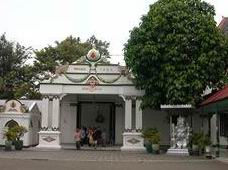 The
Sultan's Palace or Kraton, with its grand and elegant Javanese
architecture, lay in the centre of the city. It was founded
by Pangeran Mangkubumi I. He choose the right for the site of
the building, right between Winongo River and Code River a swamp
area that dried up then. The Sultan's Palace stretches from
the north to south. the front yard of the Sultan Palace is called
Allun-All;un Utara ( North Square) and the back yard called
Allun-Allun Selatan (South Square ). The design of this historical
building demonstrates that the Palace, the obelisk (the Tugu,
the column) and the mount Merapi positioned in one line. It
is believed that the axis is blessed. In the-old times Sri Sultan
is used to concentrated his mind long this axis before leading
meeting, making decision or giving order to his people. The
Sultan's Palace or Kraton, with its grand and elegant Javanese
architecture, lay in the centre of the city. It was founded
by Pangeran Mangkubumi I. He choose the right for the site of
the building, right between Winongo River and Code River a swamp
area that dried up then. The Sultan's Palace stretches from
the north to south. the front yard of the Sultan Palace is called
Allun-All;un Utara ( North Square) and the back yard called
Allun-Allun Selatan (South Square ). The design of this historical
building demonstrates that the Palace, the obelisk (the Tugu,
the column) and the mount Merapi positioned in one line. It
is believed that the axis is blessed. In the-old times Sri Sultan
is used to concentrated his mind long this axis before leading
meeting, making decision or giving order to his people.
Each part of the building has its own name. The Palace meeting
is called Pagelaran. It is the place where the formal meeting
of the Kratons's officials are held. Manguntur Tangkil Hall
is the place where the Sultan has his set. This hall is in Siti
Hinggil, Siti means ground or land while Hinggil means high,
so it called Siti Hinggil because the place where it built is
higher than any other ground around it. It was once a tiny island
on the swamp. The front gate is called Danupratopo. Two giants
called Gupalo guards it. One is called Cingkorobolo and the
other is Boloupoto. The two statues are perceived may protect
the palace from any harm or evil.The main part of the Sultan
is called Purworetno, aplce where the Sultan performes his duties.
beside Purworetno there are twostory buidings callled Panti
Sumbago. This biuding is the Sultan's privates library. The
building wher the the Sultan lives called Gedong Kuning
The palace was founded by the first Sultan, Sri Sultan Hamengkubuwono
who fathered a line of Jogjakarta kings. Relevant to the name,
the Sultan Palace has its own rules, self-governing systems
and traditional custom that is still preserved up to the present.
Lying in the center of Jogja city, this palace is the main tourist
attraction in Jogja. The palace is now dwelling place of Sultan
Hamengku Buwono X who is also the Governor of Jogjakarta special
Region. As the palace of Jogjakarta kings, physical or non-
physical, it has sacred symbol, completed with divinity, value,
culture, philosophy, history and humanity. There are a museum
displaying souvenirs from The Sultan's guests especially from
the a board called Souvenir Museum, as well as a museum of Batik
collection and museum Wayang (puppet). Equally interesting the
various forms of traditional art activities such as shadow puppets
shows, classical dances and gamelan performances are still performed
in the court and open to the public.
Birds
market:
Know
as Pasar Ngasem. It is located at the north side of Taman Sari.
This market provides hundreds type of tropical birds. In Javanese
culture, bird symbolize of men's world. This is why, transaction
of birds is quiet frequent at pasar Ngasem. Birds, which are
available at Pasar Ngasem, are mostly chirping bird, such as
perkutut, kenari, etc. Yet, there is also another species of
racing speed flyers such as dove. Thismarket also provides dogs,
rabbits, snakes, and some others pets.
Tamansari :
Tamansari Water castle is located on the street about
500 meters south of Jogjakarta Palace. Tamansari is a park,
which once was a recreational place for the Sultan an the royal
family. There were many facilities built in this complex including
a bathing pol, man-made islands, an artificial lake, and floating
mosque. Nowadays this park and castle is no more than a collection
of ruins. Tamansari was built by Sultan HB I and has functioned
as a royal recreational park until The Sultan HB III period.
The remainder of the complex which can be seen are Gapura Panggung
(the main entrance gate on the Eastside), Umbul Kawitan, (bathing
pool), Pamuncar, Gapura Agung (the Western Gate), Sumur Gumuling,
Plengkung Taman Segara, Pulau Kenanga and pulau Panembung.
Handicrafts
Batik
Batik is an art of painting which technically done by using
wax. It is presumed as non-originally Jogjanese art, since it
is also found in other regions. The oldest batik center is Wukirsari
in Imogiri. It has become a center of batik since Jogja Sultanate
(Kraton ) existed (around 1800s).Classic batik motives were
produced here. At this time, the batik painters are not only
producing exclusive batik ordered by Kraton Family, but also
producing batik with traditional motive and classic color for
common people. Batik with painted motives can be found in Taman
Sari batik Center. It is around the remain of rest area of Kraton
family - Tamansari. You can find batik in cloths, table runners,
napkins, decorative painting, etc. Taman sari batik is peculiar,
it has bright color and various motives which totally different
from classic batiks that have flora and fauna motif only. Tamansari
Batik has some motives of Jogja scenery, to include the andong
(traditional cart), Pedi cab, mask, houses, etc
Silver
Silver craft had grown since Mataram Islam existed in Kotagede
(in 1600s). At that time, Panembahan Senopati brought the silver
and gold craftsmen from Bali to Kotagede to make a royal decorations
and ceremonial equipments. Silver crafts business had prosperous
era during 1930s to 1940s when some companies got orders from
Europe and exported their products to The Nederland's and others
European countries.
Ramayana dance
This is drama dance has been performed for a very long
time, by people around Prambanan Temple every full moon,. Ramayana
is performed without dialogue, but dance and gamelan accompaniment
only. The story was taken from the relief of Prambanan temple.
And now, this ballet is regularly performed on the grand stage
built by government in Prambanan compound and other place.
Borobudur:
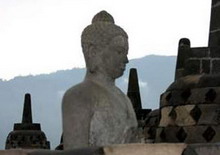 this
is magnificent Buddhist monument constructed between 750 and
850 AD when Central Java still a Buddhist kingdom. Long abandoned,
the first re-discovery and appreciation of Borobudur began in
1815 under Raffles, who was the Let.Gov. Java during the brief
period of British rule. The real work of total reconstruction
of the thousands of stone and relief took place under the Indonesian
government, who with the assistance of UNESCO, completed a 10
year restoration projection 1984. Today, Borobudur is a UNESCO
designated World Heritage Site with & levels and 1460 carved
stone relief's telling the story of Buddha and representing
the steps from the earthly realm to Nirvana. Located only 42
km from Jogja the Borobudur is the best seen in the early morning
or at twilight. this
is magnificent Buddhist monument constructed between 750 and
850 AD when Central Java still a Buddhist kingdom. Long abandoned,
the first re-discovery and appreciation of Borobudur began in
1815 under Raffles, who was the Let.Gov. Java during the brief
period of British rule. The real work of total reconstruction
of the thousands of stone and relief took place under the Indonesian
government, who with the assistance of UNESCO, completed a 10
year restoration projection 1984. Today, Borobudur is a UNESCO
designated World Heritage Site with & levels and 1460 carved
stone relief's telling the story of Buddha and representing
the steps from the earthly realm to Nirvana. Located only 42
km from Jogja the Borobudur is the best seen in the early morning
or at twilight.
The Other Temples Candi Pawon Candi Mendut
Prambanan:
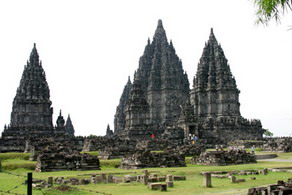 this
magnificent Shiva temple derives it name from the village where
it is located. Locally known as the Loro Jonggrang Temple, or
the temple of the "Slender Virgin", it is the biggest
and most beautiful Hindu temple in Indonesia. Seventeen kilometers
east of Jogjakarta, it is believed to have been built by King
Balitung Maha Sambu in the middle of the ninth century. Its
parapets are a domed with a bas-relief depicting the famous
Ramayana Story. The first open air theatre on the southern side
of the temples was built in 1960 and the new on the western
side of the temple in 1988. During full moon evenings in the
month from May to October, the Ramayana ballet is performed
right here. The complex of Prambanan lies among green fields
and villages. It has eight shrines, of which the tree main ones
are dedicated to Shiva, Visnu and Brahma. The main temple of
Shiva rises to a height of 130 feet and houses the magnificent
statue of Shiva's consort, Durga. this
magnificent Shiva temple derives it name from the village where
it is located. Locally known as the Loro Jonggrang Temple, or
the temple of the "Slender Virgin", it is the biggest
and most beautiful Hindu temple in Indonesia. Seventeen kilometers
east of Jogjakarta, it is believed to have been built by King
Balitung Maha Sambu in the middle of the ninth century. Its
parapets are a domed with a bas-relief depicting the famous
Ramayana Story. The first open air theatre on the southern side
of the temples was built in 1960 and the new on the western
side of the temple in 1988. During full moon evenings in the
month from May to October, the Ramayana ballet is performed
right here. The complex of Prambanan lies among green fields
and villages. It has eight shrines, of which the tree main ones
are dedicated to Shiva, Visnu and Brahma. The main temple of
Shiva rises to a height of 130 feet and houses the magnificent
statue of Shiva's consort, Durga.
The Other Temples :Kalasan, Sambisari, Sewu, Plaosan, Sojiwan
and Ratu Boko
Merapi
volcano :
lied 30 km, northern side of Jogja, when the weather
is clear, a spectacular sight of the panoramic view that covers
the surrounding forest of Plawangan and Kaliurang, and rolling
green countryside that fades into distant misty horizons of
the blue Indian Ocean can be seen easily. It is better to do
mount climbing during the dry season (April-September). There
are two paths of mount climbing to the top of Merapi. The easier
way is the north path, through Selo, Boyolali Center Java. The
most difficult path is from Kinahrejo, (9 km from the mountaintop,
but you will need around 8 hours to climb to the top due to
difficult path)
Golf Merapi:
the biggest and a most beautiful golf park of 60 ha
area with 18 holes, is a international golf course founded on
the slopes of Merapi, with exotic view to Mount Merapi at 800
m altitude. the atmosphere is very fresh. Restaurant and fitness
centre are also available here.
Dieng Plateau:
Dieng plateau lies at 2093 m altitude above the sea level, and
about 20kmS.W of Wonosobo. It has a cool climate, in the afternoon
the climate is fresh and will very cold at the night. The average
temperature is 15 C, usually it will turn into 0 C or even lower
on July and August. Beside having a beautiful scenery with temples
that had built by Caylendra Dynasty in the mid of 8 century.
Once can take Tobacco Walk in Sindoro Mountain, Wonosobo or
Tea Walk in Teh Tembi Plantation , etc. Where as Wonosobo is
a city with a fresh climate in highland which surrounded by
four mountains such as M. Sumbing (3.371m), M. Sindoro (3.162
m), M Bisma (2.365 m ) and M . Ragajembangan (2.177m). The nature
of beauty can be seen a long the way to the area which has a
high frequency of rain, especially to the north side that can
reach up to 1.500 mm per year. The beauty of Sindoro and Sumbing
can be enjoyed in the early morning from Kledung Pass and Restaurant.
Tobacco Walk in Tobacco season or Tea Walk at Tambi tea plantation
can be preserved here in any time.
Erotic temple Sukuh
The
temple Sukuh is one of the many Hindu relic in Central Java.
Located on western slope of Mount Lawu, 91`0 meters above the
sea level and 7km from Karangpandan. Sukuh was built in the
XV century just before Moslem penetrate throughout the island
of java. It is also usually called "the most erotic temple
in the world. Sukuh has a unique from structure which also shows
Indonesia original elements. more prominent rather then mostly
Indian temple elements. It is a holy structure of building for
Siva religion that in Indonesia is a symbolize by phallus which
visualizing in real as a man sex organ. The architecture alone
set Sukuh apart. It is a stepped, truncated pyramid, and it
looks very like the Mayan temple of Yucatan an Guatemala in
central America. The temple is a spiritual monuments with a
complete relieves that really enchanting and rare
Gedong Songo Temple
The temples were built between AD 730 and 780, except
for the first one encountered along the path leading up to the
others, which may be 30 years younger. The mane for the complex
is not the original one, nor it literal count of the structures;
the number9 has numerogical significance in java culture. The
temples are more or less evenly spaced between 100-200 meters
apart on individual plateaus or ridges projecting horizontally
from the mountain. Ratu
Boko Heritage Site
At the complex of Ratu Boko heritage site, we can find
variety inheritance of archaeological sites. Every structure
is arranged in good harmony and surrounded by fence. There are
many gates connecting the fence completed with stairs, terrace
and trail. Besides those sacred buildings, there are also other
building s like ponds and caves. The name Kraton given by the
local community around that area indicates that Ratu Boko site
was the living area and the center of government as well at
that time.
Ratu Boko site was built by Rakai Panangkaran in 792 AD and
called Abhayagiri Wihara. Rakai Panangkaran built Abhayagiri
Wihara after resigning from his throne. He ruled from 764
784 AD and than continued by his successor who is in fact his
son, Rakai Panarabwan. Fifty three year lather (856
AD), the name Ratu Boko had changed into Kraton Walaing which
proclaimed by Rakai Walaing pu Kumbhayoni who recognized
as the Vasal King. He ruled from 856-863 AD and called himself
as the descend of Rakai I Hulu. Some opinion said that the process
of renovation could become attraction for the tourists, because
it is a rare occasion for tourists to see the renovation process
lively.
Back

|
|